Images

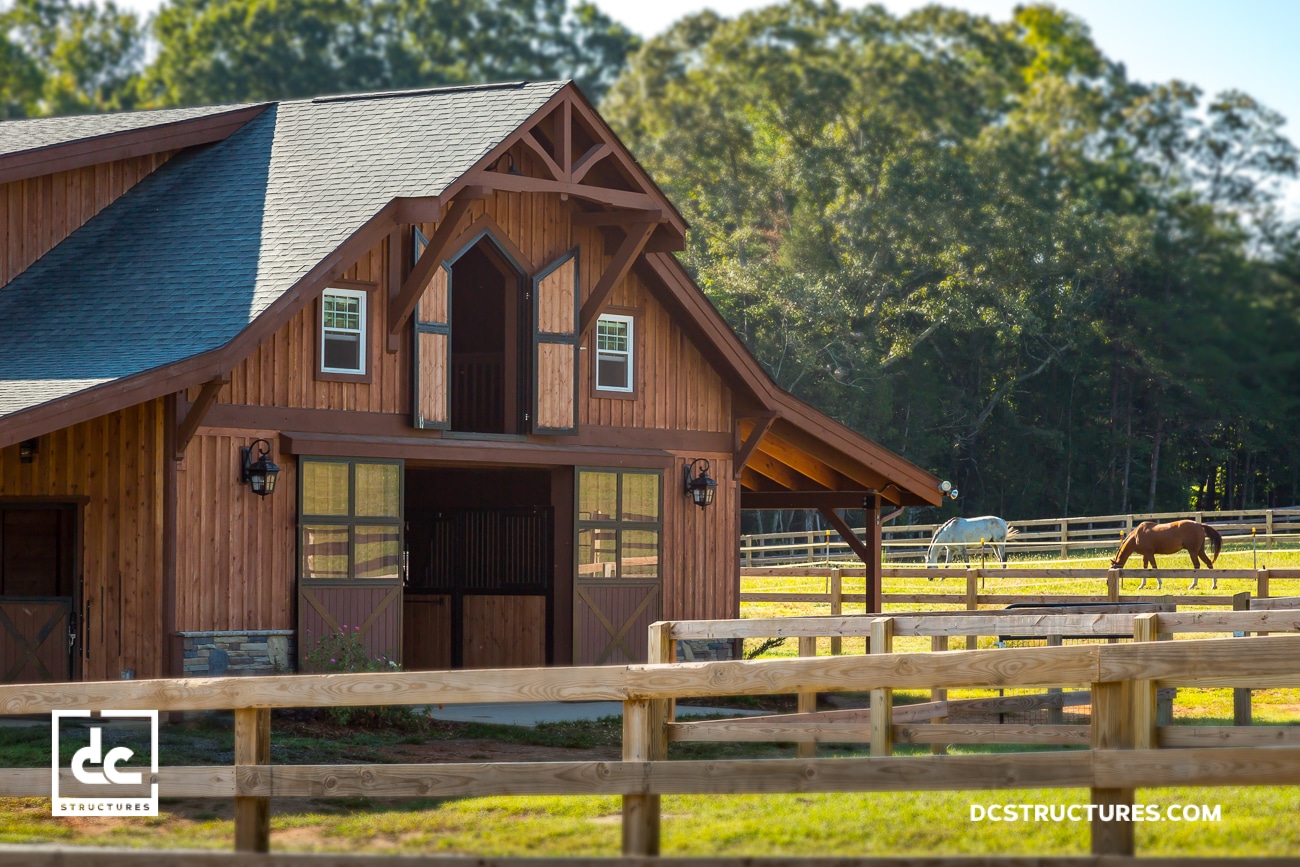
Best of Mane Street: Horse Stall Showcase

DC Structures specializes in top-of-the-line horse barn kits, with horse stall designs that are fit for a stallion. Whatever your equestrian needs, we’ll work with you to modify your plans and produce the best possible horse stall setup for your unique situation.

Take a look at our horse stall showcase to see how we’ve turned our clients’ dreams into happy homes for their horses. Get started on your own dream barn by requesting our digital catalog today.


Farm Composting: Don’t Waste It, Replace It

Weighing the pros and cons of farm composting with your barn project?

If you’ve spent time on a farm or out in the wild, you’ve likely taken note of the interconnected nature of bio habitats. Composting is a man-made process that exemplifies the natural cycle of decomposition and fertilization.

First, plants are grown in nutrient-dense soils. Then, nutrients from that plant are returned to the earth, whether through natural decomposition or manure. Finally, this re-introduction of nutrients replenishes soil health, which in turn supports the growth of the following season’s crops.

When an apple rots and falls to the ground, for example, it will eventually decompose and fertilize the soil. Replenishing dirt with these nutrients is what allows the apple tree and other surrounding plants to continue bearing fruit.

There are a number of ways to compost—and when it comes to choosing the process that’s right for you, there’s really no wrong answer. Compost methods range from aerated pile churning to sophisticated vermiculture setups. The only thing holding you back is the kind of system your space will allow.

Apartment composters for instance are likely stuck with small indoor bins that hold little food waste. On the other hand, homes with small yards can usually support larger, outdoor bins. When it comes to farm composting, though, the sky’s the limit!

Whatever the scale of your composting needs, DC Structures can set you up with a reliable system that will reduce your property’s environmental footprint in a way that is clean, simple and efficient.

O2Compost: Get the most out of your compost

DC Structures partners with O2Compost—a Pacific Northwest environmental consulting firm—to help our clients design the best possible composting setups for their properties.

O2Compost creates cost-effective systems that utilize the aerated static pile composting method. The farm composting setups that O2Compost designs can process all organic materials. This includes food scraps, landscaping debris and livestock manure.

For example: Our clients at Last Chance Ranch in West Linn, Oregon commissioned DC for both a horse barn and a covered riding arena. With equestrian pursuits playing such a prominent role on their property, these customers were looking for a solution to their horses’ manure piles and the flies they attract.

O2Compost designed an aerated composting system that matches the aesthetic of the ranch’s barn and arena. More importantly, it has completely solved our client’s problems with manure stench and flies. What’s even better is that they are now creating their own nutrient-rich fertilizer essentially free of cost. 

Composting is a simple and cost-effective way to promote responsible environmental stewardship. Once in place, this process will save you time and resources that would otherwise be spent on waste disposal and fertilizer.

To learn more about O2Compost’s aerated static pile composting method, visit their website. Thinking about adding a new barn or barn-style home to your property? Request our digital catalog to get a start on your dreams.

Structural Snow Loads You Can Count On

In regions of the country where annual snowfall is high, buildings must be adequately engineered to withstand heavy snow loads.

Snow loads refer to the weight of snow that a building’s rooftop is designed to hold up against. It takes extensive calculations to determine the proper engineering for each building’s specific needs.

Structural engineers rely on international building codes to determine appropriate snow load designs. In winter-heavy areas, these requirements are usually elaborated upon by state and local governments.

If snow is a concern, it’s important to work with engineers who are familiar with regional-specific building codes. Insufficient design has the potential to be costly in every sense of the word.

The Many Faces of Snow

Just like the individuality of each snowflake that comes together to form a winter scene, every snow event has its own unique nature. This makes it especially tricky to intuit how differing snow conditions will affect each individual building.

The term ‘snow event’ can refer to one large winter storm or a series of storms that bring multiple bouts of precipitation.

These winter storm systems present a number of dangerous challenges. On the one hand, making an effort to remove snow from a rooftop is more of a risk than it’s worth. On the other, heavy snowfall over extended periods of time increases the chance of structural deficiency or perhaps even collapse.

snow loads
This DC Structures party barn in Damascus, Oregon is engineered to withstand the Willamette Valley’s dense and heavy snow loads—when it does snow, of course.

Planning for Snow Loads

Design for proper snow loads must be weighed against several important considerations. For example, places where snow is generally light and dry are going to be a lot less troubling than regions with wet and heavy snow.

In other words, 1 foot of snow in Wisconsin is not equal to 1 foot of snow in Oregon. This inconsistency in snow density is the result of regional variations such as humidity and elevation. Freezing rain and snow that melts and then freezes can also complicate matters.

Additional factors that affect structural snow loads include the amount of wind the building is exposed to, as well as the thermal conditions of the structure.

Roofing materials and slope, identification of potential ice dam formations, snow drifting and sliding, uneven distribution of the weight of snow on a rooftopall of these variables must be thoughtfully addressed throughout the structural engineering process.

DC Structures has accommodated increased snow load requirements for clients in harsh-winter regions across the country. Our kits are always engineered to the highest safety standards.

Take a look at our catalog and start planning your dream building today.

Mono Slab Foundations: One and Done

Mono slab foundations are a fast, strong, and reliable alternative to traditional foundation building methods. This foundation type is ideal for structures built from pre-engineered materials packages.

Mono slab foundations are formed with a single pour of concrete. These single-pour slabs are less prone to inconsistencies, and benefit from a relatively low time investment. Easily reinforced, concrete slab foundations provide excellent durability for the buildings they support.

Structures that utilize mono slab foundations score LEED-certification points due to their efficient use of building materials and better insulation. That they require minimal excavation and no expensive rock drilling or blasting makes them particularly attractive to clients in regions with rocky, hard soils.

DC Structures relies on monolithic slab foundations for all its kits. This reinforces our core message of efficient and quality service, as our entire process is designed to save you time, money and stress-related headaches.

Mono Slab Foundations: Harder, Better, Faster, Stronger

Traditional foundation styles will eat up a lot of your time and resources—and that’s before you’ve even begun your build! This is doubly true in rocky-soil regions.

One of the biggest problems with other foundations is that they call for concrete to be poured in different stages. Pouring concrete in stages means you must wait for each section to set and harden entirely before moving onto the next. This might not seem like a huge hassle, but labor costs over time add up fast.

Mono slab foundations support DC Structures’ signature style of construction—post and beam buildings with dramatically open interiors. Post-and-beam construction makes use of untreated heavy timbers.

Untreated lumber is preferable to chemically-treated wood due to its elegant appearance and lack of toxic chemicals. Treated posts must be covered for this reason, and have a short shelf life of 40 years before they begin to rot.

Of course, mono slab foundations aren’t always the best solution. If you live in a place where freezing is a serious concern, you might need a thicker slab or an alternative foundation solution.

Request our digital catalog to get a better sense for how our kits could be modified into your dream structure. We design packages that are built to last, impress and save you time and energy.

The Pre-Engineered Package Advantage

If you’re thinking about adding a barn or barn-style home to your property, then you’re probably weighing the pros and cons of a pre-engineered package.

Don’t let the words kit or package fool you into thinking pre-engineered structures are of lesser quality than their custom-built counterparts. Kits take all the guesswork out of designing and building a structure, and save you money in the process. This is all without compromising on the quality or originality of your building.

Barn kits are efficient by design, because no materials are wasted and the structure is built relatively fast. This will save you from labor-cost overages and countless sleepless nights.

While plenty of barn kit companies sell cheaply-made, cookie-cutter kits, one has set a high standard for the industry. DC Structures’ pre-engineered packages are builder-friendly and built to last. You can count on our knowledgeable team of designers and engineers to guide you through the process.

Pre-Engineered for Success

Pre-engineered packages offer the benefit of trusting someone else to do the heavy lifting, and peace of mind knowing that all materials and engineering requirements will be accounted for. We make our kits with high-quality materials, and you can rest easy knowing the hardware is trusted and certified.

All of DC Structures’ kits have been pre-engineered to our standard loads. With years of experience spanning projects across the U.S., the DC team is well equipped to ensure all blueprints are compliant with your locally-mandated regulations. Wet-stamped plans are available if needed.

We include a detailed materials list for your chosen contractor in all our kits. Additionally, step-by-step construction details will make the structure easy to build. Unlike custom builds, kits offer the ease of knowing there will be no change orders for materials shortages.

Contrary to popular belief, structures are easily personalized. Our process starts with selecting a kit model and then making modifications to both the floor plan and finishes. Once your plans are finalized, it’ll feel like a custom build.

Take a look at our catalog for a better idea of how we can turn your dreams into actionable plans. It is just as possible to do so with a pre-engineered package.